
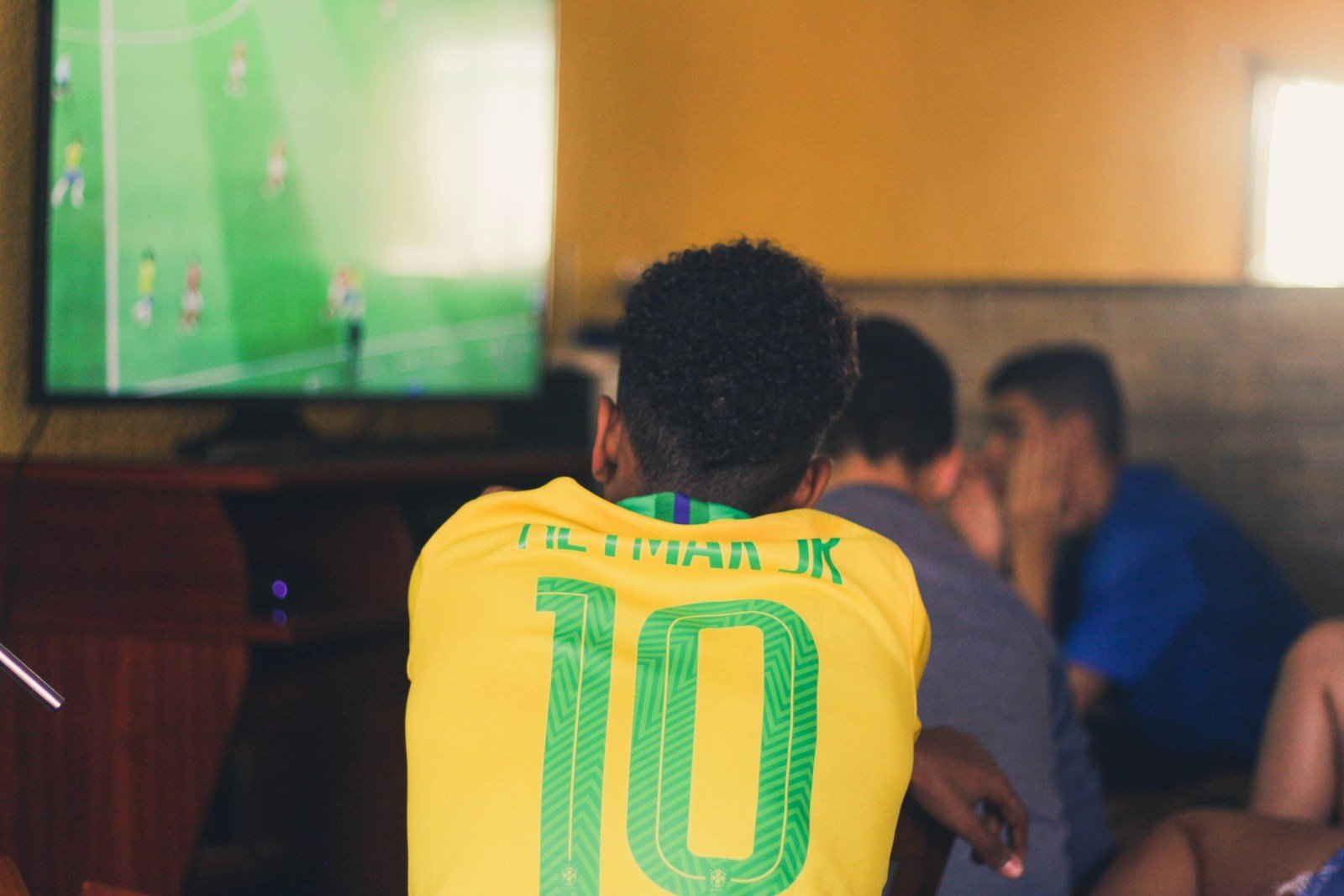
When I was a boy in Nigeria, the most exciting part of my day often had nothing to do with school or chores. It was the walk to the gaming shop in the neighborhood, a small room with a few screens, some worn-out controllers, and a crowd of kids who all wanted the same thing. We would sit there anxiously waiting for our turn, watching whoever was playing and quietly planning what we would do differently. Some kids were driving through city streets, others were racing bicycles, but my eyes were always on the football. For about twenty naira you got ten minutes, and those ten minutes felt like the whole world. I almost always picked Real Madrid, with Zidane pulling the strings and Ronaldo leading the line, and when my turn came my heart would actually race. I made friends in that room with boys whose names I’ve long forgotten and whom I’ll probably never see again, but for those afternoons we were bonded by a game we all loved.
Back then I used to dream about having my own console, and electricity that never went off, so I could play whenever I wanted for as long as I wanted. Today I have exactly that. I have the console, the steady power, and the means to buy any game I like. And somehow, the magic is gone. The game that used to feel like a gift now feels like an obligation. Playing EA Sports FC, the game that used to be called FIFA, feels like something I’m supposed to do rather than something I can’t wait to do. Even watching live football, which was once the highlight of my week, has started to feel like a chore.
That hurts to admit, because football gave me so much. I grew up watching players who made the game feel like art. Ronaldinho played with a smile on his face that made you believe football was supposed to be fun. At Barcelona he did things nobody had imagined, and in 2005 he was so brilliant at the Bernabéu that even Real Madrid’s own fans stood up and applauded him. I still remember that toe-poke goal against Chelsea, a finish that made no sense until you saw it go in. Watching him was like watching someone play in the street with his friends, except he was doing it against the best teams in the world.
Then there was Cristiano Ronaldo’s 2007-08 season at Manchester United. He scored 42 goals in all competitions as a winger, won the Premier League and the Champions League, and headed in the opening goal of the final in Moscow. That season he won his first Ballon d’Or, and it felt earned in every sense. He was hungry, explosive, and almost unstoppable, and you could feel his ambition through the screen.
I think about Diego Milito at Inter Milan in 2009-10 too. He wasn’t the most famous striker in the world, but in that one season he scored in every final that mattered, including both goals against Bayern Munich in the Champions League final, as Inter won the treble under Mourinho. He proved that you didn’t need to be a superstar to become a legend, only to show up when it counted most. These players were nothing alike, yet every one of them gave us the same gift. They made us fall in love with football over and over again.
The FIFA games gave me something else I didn’t expect, and that was music. The soundtracks used to be little treasures. You would sit in the menus building your team, and a song you’d never heard would come on and stay with you for years. That’s how I first heard Catfish and the Bottlemen. Their song “Cocoon” came on while I was clicking through the menus, and something about it grabbed me. It made me dream about Wales, about love, and about companionship, all while I was sitting in Nigeria playing a game I adored. Today they’re one of my favorite bands, and I’m planning a trip to Wales just to see where they’re from and understand a little more about them. All of that curiosity and affection started from a football game’s menu screen. That’s how much these games used to give us beyond the football itself.
So what went wrong? The more I think about it, the more convinced I am that the magic didn’t simply fade on its own. It was taken, slowly and deliberately, by people who looked at something beautiful and saw only a way to make more money. Football was always a business to some degree, but somewhere along the way the business stopped serving the game and the game started serving the business. The people running it today often seem less like custodians of a sport and more like executives managing a product, and the fans who gave it life have become customers to be squeezed.
You can see it in the governing bodies first. FIFA, the organization meant to protect the world’s game, spent years at the center of corruption investigations, with officials arrested and accused of taking bribes over tournaments and broadcasting rights. Instead of humbling the people in charge, it seems to have taught them nothing. Tournaments keep getting bigger, not because fans asked for more but because more matches mean more broadcast money and more sponsorship deals. The World Cup has grown to 48 teams, the Club World Cup was expanded into a month-long event, and the calendar is now so packed that players break down from exhaustion. When I was a boy, a big match felt like an event worth waiting for. Now there are so many games that none of them feel special, and I think that’s exactly why watching has started to feel like a chore.
The clubs have followed the same path. In 2021, twelve of Europe’s biggest clubs tried to break away and form a Super League, a closed competition built to guarantee their own revenue no matter how they performed. It collapsed within days because fans across Europe rose up against it, but the fact that it was attempted at all told me everything about how the people at the top see the sport. Ticket prices keep rising, matches are scheduled around television audiences rather than the people in the stands, and some clubs are now owned by billionaires and wealthy states who treat them as investments, trophies, or tools for their own image.
The game I loved in that little shop has gone the same way. It’s telling that the name FIFA itself disappeared from the series because the two organizations reportedly couldn’t agree on how much money the license was worth. Even the title of the game I grew up with became a casualty of a business negotiation. Today so much of EA FC revolves around Ultimate Team, where the fastest way to build a great squad is to keep spending real money on digital packs with random rewards. It’s a model so close to gambling that some countries have restricted it, and it earns enormous amounts every year. When a company makes that much from players opening packs, it has little reason to take risks on the actual football, so each new edition feels like a small update with a new price tag. Even the soundtracks, once a place to discover something new, no longer carry the same wonder. I think that’s why playing feels like a must and not a want. The game is no longer designed to delight me. It’s designed to keep me engaged and spending.
Underneath all of it is plain human selfishness. Wealthy bureaucrats, executives, and owners decided that more was always better: more money, more matches, more content, more ways to spend. But that isn’t how happiness works. The best memories I have of football and FIFA came when we had less, when ten minutes cost twenty naira, when I had to wait my turn, and when every match felt precious because it wouldn’t last. Yes, we paid the shop owner to play, but it was an honest trade. We paid for ten minutes and got ten minutes, and nobody was designing the experience to keep us hooked and spending. We were just kids falling in love with a game, and that love was never something you could put a price on, no matter how hard they’ve tried.
So I find myself asking the game I loved a question I can’t quite answer. You gave us so much joy, so many friendships, and so many memories, and then little by little you took it all away without warning and without asking us. I still remember who I was in that small gaming shop, sitting on the edge of my seat with my heart pounding, and part of me hopes that one day the people running football and the people making these games will remember that boy too. Maybe then they’ll understand that what made the game great was never the money. It was the wonder of it all, and we would give almost anything to feel it again.